Why ISO-Certified Lubricant Suppliers Matter for Pakistan’s Industrial Sector
Downtime is costly in Pakistan's industrial sector, and there are few warning signs of equipment breakdowns. However, inconsistent lubricant quality is among the least-addressed factors contributing to machinery breakdowns. In textile mills in Faisalabad, cement plants in Chakwal, and even manufacturing plants in Karachi's industrial areas, lubrication quality is often a one-factor, invisible variable in determining the performance of critical machinery.
At this point, ISO-certified lubricant suppliers are no longer purely a procurement choice but a strategic requirement. In a world where production efficiency directly influences competitiveness, there is nothing like a certification label; it is a quantifiable guarantee of reliability, consistency, and controlled manufacturing processes that industrial processes cannot afford to overlook.
Understanding ISO Certification in Industrial Lubricants
The main concern of ISO certification in the lubricant industry is standardization and process control. It ensures that lubricant production aligns with globally recognized quality management standards, particularly ISO 9001 and other relevant standards.
For industrial purchasers in Pakistan, this means each batch of lubricant is manufactured in controlled environments, tested to meet specifications, and approved by established quality assurance programs. Variability is not a strong factor with non-certified suppliers, but with ISO-certified lubricant suppliers, viscosity, thermal stability, resistance to oxidation, and control of contaminants are consistent.
Practically, ISO certification decreases uncertainty. When the industrial work process requires heavy machinery that operates 24/7, this consistency directly translates into fewer breakdowns and more regular maintenance schedules.
Why ISO Certification Matters for Pakistan’s Industrial Sector
The industrial sector in Pakistan is subjected to unique pressures: the cost of energy is high, the budget on maintenance is limited, and the production schedule is frequently aggressive. Under these circumstances, even low-level inefficiencies in industrial lubrication may turn into huge financial losses.
ISO certified lubricant suppliers can reduce these risks since each product supplied is in line with the reported quality control processes. This is especially relevant in industries like textiles, steel manufacturing and cement production, automotive assembly, and power production, whereby machines are subjected to extreme load conditions.
Lack of quality assurance by ISO means that there is variability in the performance of lubricants in the industries, and this may result in uneven wear, excessive overheating of equipment, and early wear of equipment. These problems over time add up to increased cost of operation and decreased life of assets.
ISO Standards and Their Role in Lubricant Manufacturing
ISO 9001, a quality management system, is the most used framework in the production of lubricants. However, advanced manufacturers also align with ISO 14001 for environmental management and ISO 45001 for occupational health and safety.
All of these standards are used in the production of lubricants to not only guarantee consistent manufacturing of lubricants but also make the manufacturing process environmentally sound and safe to work in the industry. This is especially true in Pakistan, where growing regulatory awareness and environmental issues are influencing procurement decisions.
The ISO standards also necessitate records at all levels, including the sourcing of raw materials, blending, filling, storage, and distribution. This traceability enables industrial purchasers to check the integrity of products and guarantee that each lubricant drum may be traced to a controlled production batch.
The Link Between ISO Certification and Industrial Lubrication Performance
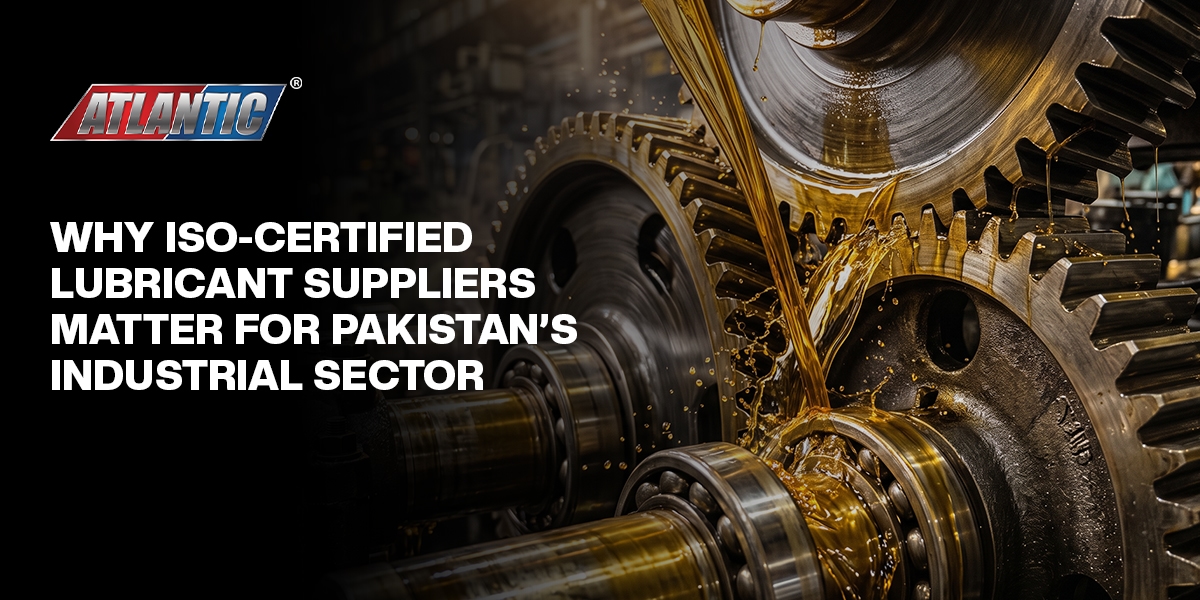
Industrial lubrication is not only the art of reducing friction but also the art of making the whole mechanical ecosystem optimal. It is on the basis of the necessity of high-performance machinery that relies on lubricants that are stable under pressure, are not subject to thermal degradation, and are resistant to corrosion and contamination.
ISO-certified lubricant suppliers make sure that these performance parameters are not left to chance. Rather, they are thoroughly tested and validated prior to reaching the customer. The result is better equipment reliability, less unplanned downtime, and increased efficiency in the use of energy throughout the industrial operations.
With marginal efficiency gains in lubrication, cost savings over the long run can be achieved even in the energy-sensitive environment of Pakistan.
How ISO Certification Strengthens Product Quality Assurance
Quality assurance of lubricants is an organized procedure that entails inspection of raw materials, batch testing, laboratory verification, and certification of the final product. The systems that are certified by ISO are strict in these steps and allow very little variation.
In the case of industrial buyers, it implies that the lubricant delivered to them is not only within the specifications as indicated in the specification sheets but also that it is made to the same standard every time. Such predictability is necessary in large-scale operations where even a little fluctuation can upset production cycles.
Conversely, non-certified suppliers might not have standardized testing procedures, and therefore, the inconsistent performance results obtained will have direct implications on the machine operational efficiency and maintenance schedules.
Operational Efficiency Through Certified Lubricant Suppliers
In industrial environments, operational effectiveness is closely related to the reduction of unplanned downtime. Lubricants are very important in fulfilling this goal through wear reduction, temperature control, and smooth mechanical movement.
ISO-certified lubricant suppliers help in operational efficiency by making sure that lubricants are reliable in their workability under changing loads and temperatures. This dependability decreases emergency maintenance interventions and enables the maintenance teams to adopt preventative measures as opposed to reactive ones.
This is a big advantage to industries in Pakistan where continuity in production is a key requirement to stay competitive in the local and international markets.
Risk Reduction in Industrial Procurement Decisions
Risk mitigation is becoming a major concern to procurement teams in industrial organizations. Although it is common to view lubricants as consumables, they have a direct impact on the integrity of the assets and stability of production.
The ISO certification minimizes procurement risk by ensuring verifiable quality of manufacture and supplier credibility. It makes sure that the suppliers adhere to audited processes, have documented quality systems, and adhere to international standards.
It is particularly significant in the supply chain environment in Pakistan, where sometimes fake or low-quality industrial goods get into the market. A layer of protection against such risks is provided by ISO-certified lubricant suppliers that have transparent and auditable production systems.
Why Choose Atlantic Grease and Lubricants Pakistan
In industries where reliability, consistency, and long-term equipment safety are critical, it is not a choice to select an ISO-certified supplier; it is a necessity. Atlantic Grease and Lubricants Pakistan stands as a trusted partner for industrial organizations that desire the services of high-performance lubrication with strict quality control mechanisms and internationally compatible production standards. Atlantic, with a keen interest in industrial lubrication performance, consistency, and efficiency, provides lubricants that help sustain the challenging industrial environments in Pakistan.
You may have heavy machinery, continuous production lines, or high-load mechanical systems, but any product that Atlantic manufactures will be of high-quality standards that will directly translate to sustained equipment reliability and minimal downtime.